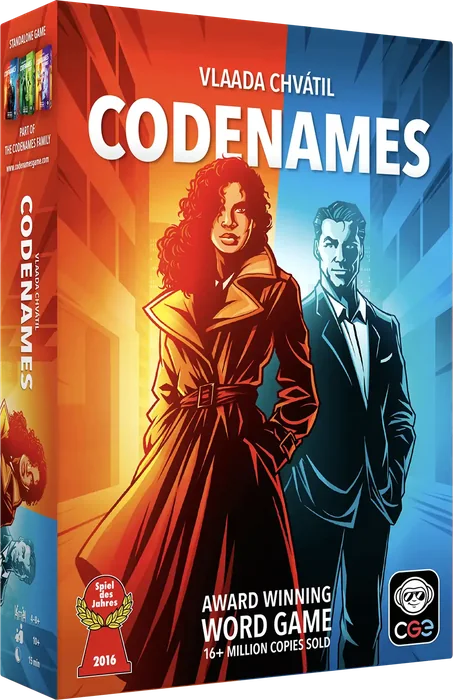
A grid of 25 words. Your spymaster says 'ocean, three' and stares at you with desperate intensity. Is it WAVE? SHARK? Surely not BED... Codenames weaponizes the gap between what a word means to you and what it means to your best friend, and a decade later no party game has dethroned it.
How it plays
Two teams race to identify their agents hidden in the word grid. Each team's spymaster gives one-word clues plus a number — 'fruit, two' points at APPLE and ORANGE, hopefully not at the opposing team's words, and absolutely not at the assassin, which loses the game instantly.
Rounds take twenty minutes, rules take ninety seconds, and the word deck is functionally bottomless.
What makes it shine
The genius is that the pressure lands on the clue-giver, not the guessers — so shy players can happily guess while the show-offs sweat over four-word connections. Every group develops legends: the 'Beyoncé, five' that worked, the assassin hit that ended a friendship for one evening.
It scales from four players to a full holiday living room, sober or otherwise, and the $20 price makes it the best entertainment-per-dollar in the hobby.
Where it stumbles
It needs at least four people who share some cultural wavelength — mixed-language or mixed-generation tables can stall. A timid spymaster giving endless 'one' clues can slow the room, and the head-to-head format leaves odd counts slightly awkward. For couples, get Codenames: Duet instead — it's excellent.
Who it's for
Anyone who ever hosts more than three people. It's the closest thing modern gaming has to a universal social tool — pack it for holidays, cabins, and office parties.
The Verdict
Still the reigning party game: infinitely replayable, endlessly quotable, and the best $20 in the hobby.
What we loved
- Ninety-second teach for any crowd
- Scales to huge groups
- Endless replayability
- Impulse-buy price
What holds it back
- Flat with fewer than four players
- Needs shared cultural reference points
- Slow spymasters can stall the fun