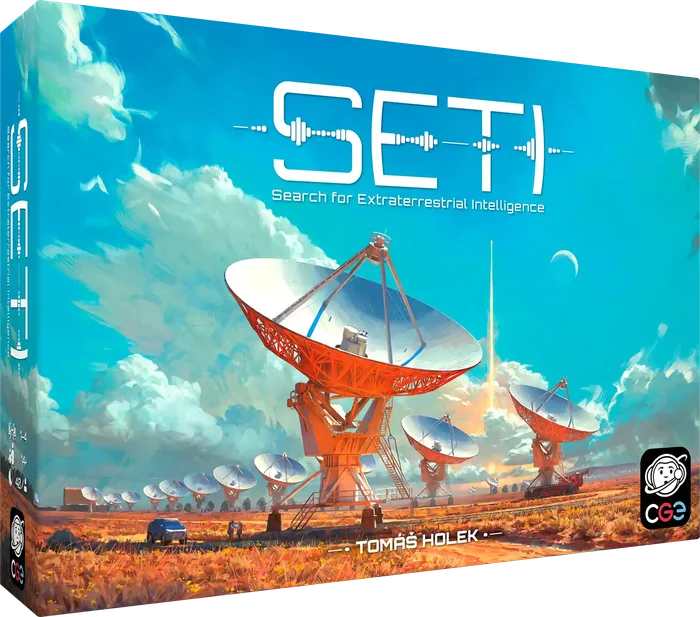
Every few years a heavy euro comes along that makes the spreadsheet crowd and the theme crowd stop arguing. SETI is that game. You run a space agency scanning nearby star systems for signs of life, and the remarkable thing is how much it feels like that — the slow sweep of telescopes, the long silence, and then the heart-jump moment a signal comes back.
How it plays
Over five rounds you spend actions launching probes, rotating a physical solar-system dial, landing on planets and moons, and pointing ground-based telescopes at distant sectors. Everything feeds a tech tree and an income engine, and the interlocking systems are pure Czech Games polish — tight, readable, and stingy in the way good euros are.
The hook is discovery. Partway through the game, someone's scanning finally uncovers one of five alien species — each with its own mini-ruleset that changes the back half of the game. One species hides among the asteroid belts; another rides comets around the dial. You never know which you'll get, and that variability keeps the game fresh across many, many plays.
What makes it shine
The rotating solar system is more than a gimmick. Planets literally move relative to your launch windows, so a probe fired now might arrive somewhere better in two rounds. Planning around orbital mechanics sounds intimidating; in practice it's intuitive and constantly interesting.
It's also gorgeous on the table without being cluttered. Iconography is clean, the science is real (the card art leans on actual exoplanet research), and the solo mode is one of the better bot implementations we've played.
Where it stumbles
This is a 3.4-weight game that plays best at 40 minutes per player — with four newcomers you're looking at a three-hour teach-and-play. And while the alien discovery is thrilling, a couple of the species are clearly swingier than others, which can rankle the pure-optimization crowd.
Who it's for
If Wingspan is your ceiling, SETI is a stretch goal — get a few medium euros under your belt first. But if you love Terraforming Mars or Ark Nova and want something with a stronger sense of wonder, this is the best heavy euro of its generation, and it deserved every award it won.
The Verdict
A masterpiece of thematic euro design — mechanically tight, genuinely wondrous, and endlessly replayable thanks to the five alien species.
What we loved
- Theme and mechanics in rare harmony
- Alien discovery mid-game is a jaw-dropper
- Rotating solar system creates real orbital planning
- Excellent solo mode
What holds it back
- Long with 4 players, especially new ones
- Some alien species swingier than others
- Table hogs: needs a big surface